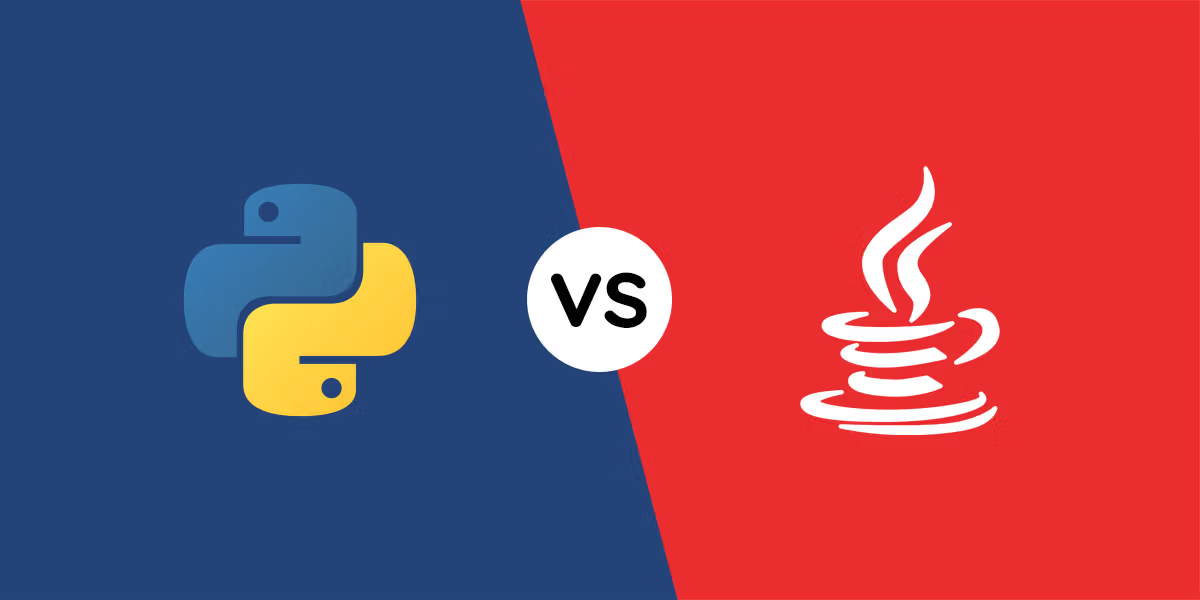
Python vs Java is one of the most common comparisons for beginners who want to learn programming seriously. Both languages are mature, widely used, and capable of building real-world software. Python is known for simplicity, fast development, automation, data science, and artificial intelligence. Java is known for structure, performance, scalability, Android development, and large enterprise systems. The right choice depends on what you want to build and what kind of developer career you want to pursue.
This guide is not a literal translation of the Portuguese version. It is an English-first comparison designed for readers who want a clear, practical answer. You will see how Python and Java differ in syntax, learning curve, performance, job opportunities, backend development, data science, enterprise software, Android, and long-term career value. If you are new to programming, start with this Python beginner guide to understand the basics before choosing a specialization.
Quick Answer: Python or Java?
Choose Python if you want an easier first language, faster prototyping, automation, scripting, data analysis, machine learning, artificial intelligence, or backend APIs with a clean syntax. Python lets you focus on logic early because it requires less boilerplate than Java. That is why many schools, bootcamps, analysts, researchers, and beginners choose it as their first programming language.
Choose Java if you want to work with large enterprise systems, Android development, high-performance backend applications, banks, insurance platforms, payment systems, and long-lived corporate software. Java has more structure, stronger static typing, and a huge ecosystem around the JVM. It may feel heavier at first, but it teaches discipline that is valuable in large codebases.
What Python Is Best For
Python is a general-purpose language designed around readability. Its code often looks close to plain English, which makes it approachable for beginners and productive for experienced developers. You can use Python to write small scripts, build web APIs, automate business tasks, clean data, train machine learning models, scrape websites, create internal dashboards, and connect systems together.
The biggest strength of Python is how quickly you can turn an idea into a working program. You do not need to create a class just to print text or test a small function. You can open a file, process a spreadsheet, call an API, or build a prototype with very little ceremony. That makes Python excellent for learning and for solving practical problems at work.
Python also dominates many data-focused fields. Libraries such as NumPy, Pandas, Matplotlib, Scikit-learn, TensorFlow, and PyTorch make it the default language for many data science and AI workflows. If that is your goal, explore Pandas in Python, NumPy in Python, and the data science category.
What Java Is Best For
Java is a general-purpose, object-oriented language that became popular because of portability, reliability, and strong tooling. Java code runs on the Java Virtual Machine, which makes it possible to run the same application across different environments with consistent behavior. This design helped Java become a standard choice for enterprise software, backend systems, banking platforms, Android applications, and distributed services.
Java is more verbose than Python, but that structure is useful in large teams. Static typing catches many errors before runtime. IDEs such as IntelliJ IDEA and Eclipse provide powerful refactoring, navigation, and debugging support. Frameworks such as Spring Boot are widely used for APIs, microservices, authentication, database access, and corporate systems. The official Java Tutorials from Oracle are a strong reference for learning the language properly.
Java is often a better fit when the project needs long-term maintainability, strict architecture, strong typing, high performance, and large development teams. It may take longer to write the first version, but the structure pays off when the system grows.
Syntax and Learning Curve
Python usually wins for beginners because the syntax is shorter and easier to read. You can write a simple conditional without declaring types, creating classes, or adding semicolons. Python uses indentation to organize code blocks, which forces readable formatting. That can feel strict at first, but it keeps programs visually clean.
# Python
name = "Maria"

if name == "Maria":
    print("Hello, Maria!")
Java is more explicit. Even a small program needs a class and a main method. This extra structure can frustrate beginners, but it also introduces concepts used in professional software: types, classes, methods, access modifiers, compilation, and project organization.
// Java
public class Main {
    public static void main(String[] args) {
        String name = "Maria";

        if (name.equals("Maria")) {
            System.out.println("Hello, Maria!");
        }
    }
}
If your priority is learning programming logic quickly, Python is easier. If your priority is learning enterprise-style structure from the beginning, Java is valuable. For a deeper foundation in Python logic, read this guide on programming logic with Python.
Typing: Dynamic vs Static
Python is dynamically typed. You do not need to declare the type of a variable before using it. A variable can hold an integer now and a string later. This makes Python flexible and fast to write, especially for scripts and prototypes. The downside is that some type-related errors appear only when the code runs.
value = 10
value = "ten"
Java is statically typed. You must declare the type of each variable, method parameter, and return value. That feels more verbose, but it catches many mistakes before the program runs. In large systems with many developers, static typing can reduce ambiguity and make refactoring safer.
int value = 10;
// value = "ten"; // This would be a compile-time error
Modern Python can also use type hints, which help editors and tools catch mistakes earlier. But Java’s type system is stricter by default. If you want to understand Python’s flexible data model, start with this overview of Python data types.
Performance: Which Is Faster?
Java is usually faster than pure Python in CPU-heavy applications. Java code is compiled to bytecode and executed by the JVM, which uses advanced runtime optimization techniques. For long-running backend services, high-throughput APIs, and computationally intensive business systems, Java can deliver strong performance and predictable behavior.
Python is generally slower in raw loops and CPU-bound tasks because CPython has runtime overhead. However, that does not automatically make Python a bad choice. Many Python applications spend most of their time waiting for files, databases, web APIs, or user input. In those cases, raw language speed is not the bottleneck. This article explains why Python can be slow and when it actually matters.
Python also becomes much faster when heavy work is delegated to optimized libraries. NumPy and Pandas often run critical operations in compiled native code. That is why Python is practical for data science despite being slower than Java in many pure language benchmarks. Always profile before choosing a language based only on performance assumptions.
Backend Development
Both Python and Java are excellent for backend development, but they serve different styles. Python frameworks like Flask, Django, and FastAPI are great for APIs, prototypes, dashboards, internal tools, and data-driven products. They make it easy to build quickly and keep code readable. If you want to start with Python backend, this Flask tutorial is a practical entry point.
Java shines in enterprise backend development. Spring Boot is one of the most common frameworks for production APIs, microservices, and corporate applications. Java projects tend to have more boilerplate, but they also have strong conventions, powerful tooling, mature libraries, and excellent support for large teams. The official Spring Boot project page is a useful reference for understanding the Java backend ecosystem.
If you are building a small API, a startup prototype, or a data-heavy backend, Python may be faster to develop. If you are joining a bank, insurance company, large SaaS platform, or enterprise Java team, Java skills are extremely valuable.
Data Science, AI, and Automation
Python clearly wins in data science, artificial intelligence, automation, and scripting. The ecosystem is larger, the tutorials are easier to find, and the libraries are more mature for modern AI workflows. If you want to analyze CSV files, clean messy datasets, train a model, call an API, generate reports, or automate repetitive office tasks, Python is usually the better language.
Java can be used for data engineering and machine learning, especially in enterprise environments, but it is not the default learning path for most beginners in AI. Python gives you a smoother path from beginner syntax to practical data work. You can continue with cleaning messy data in Python, automating tasks with Python, and machine learning with Scikit-learn.
Android and Mobile Development
Java has a long history in Android development. Kotlin is now the preferred modern language for many Android projects, but Java remains important because of legacy apps, libraries, tutorials, and existing codebases. If your main goal is Android development, Java is much more relevant than Python.
Python can be used for mobile experiments with tools such as Kivy or BeeWare, but it is not the mainstream path for professional Android development. Python is better for backend APIs that a mobile app consumes, automation around mobile workflows, or data services behind an app. If you want to package Python into an Android app for experimentation, see this guide on how to generate an Android APK with Python.
Job Market and Career Paths
Python and Java both offer strong career paths, but the roles are different. Python appears in data science, AI engineering, backend APIs, automation, analytics, DevOps tooling, testing, scripting, and research. Java appears in enterprise backend, Android, banking systems, insurance platforms, payment processors, large-scale microservices, and corporate software teams.
If you want a beginner-friendly language with many possible directions, Python is a strong first choice. If you want a more traditional software engineering path in large companies, Java is still extremely valuable. Neither language is “dead,” and neither is a bad investment. The better choice is the one aligned with the type of work you want to do.
Community, Documentation, and Tools
Both languages have massive communities. Python has a friendly beginner ecosystem, many tutorials, simple package management with pip, and a large collection of libraries on PyPI. Java has decades of enterprise knowledge, mature IDEs, strong build tools, and a deep culture of architecture and design patterns.
For beginners, Python resources often feel easier. For large professional systems, Java resources often go deeper into architecture, testing, dependency injection, concurrency, and deployment. The difference is not only language syntax. It is the culture around each ecosystem.
Can You Learn Both?
Yes, and many developers eventually do. Learning Python first can help you understand programming logic quickly. Learning Java later can deepen your understanding of object-oriented design, static typing, interfaces, build tools, and enterprise architecture. Learning Java first can make Python feel very lightweight later, because Python removes much of the boilerplate you are used to writing.
Do not try to master both at the same time if you are a beginner. Choose one language, build real projects, learn debugging, read documentation, and practice consistently. Once you can build something useful, switching languages becomes much easier because many concepts transfer: variables, functions, loops, classes, exceptions, data structures, APIs, and testing.
Final Recommendation
Choose Python first if you want the smoothest entry into programming, automation, data science, AI, scripting, or quick backend development. Choose Java first if you want enterprise backend, Android, large-scale systems, strict structure, or a career in companies that rely heavily on the JVM ecosystem.
For most absolute beginners who are not sure what they want yet, Python is the better first language because it gets you writing useful programs faster. For students who already know they want corporate software engineering, Java is still a powerful choice. The most important step is not choosing perfectly. It is choosing one language, practicing daily, and building projects that prove you can solve real problems.