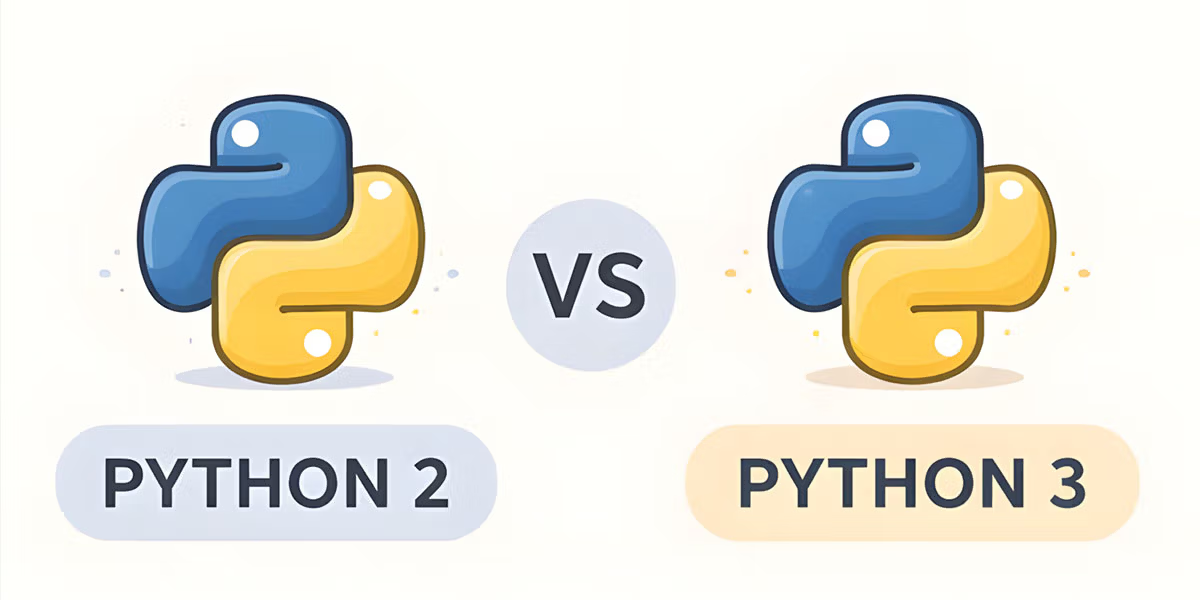
Python 2 vs Python 3 is no longer a balanced choice for new projects. Python 2 was important for many years, but it reached end of life and no longer receives official security fixes or bug fixes. Python 3 is the modern version of the language, the version used by current libraries, and the version beginners should learn today. Still, understanding the differences matters because old tutorials, legacy systems, and older codebases may still contain Python 2 syntax.
This English version is adapted for readers who want a clear comparison, not a literal translation. You will learn why Python 3 was created, what changed in syntax, how text handling improved, why integer division behaves differently, what happened to common functions, how library support shifted, and what to do if you still maintain Python 2 code. If you are just starting, read this Python beginner guide and this explanation of what Python is.
Quick Answer: Learn Python 3
If you are beginning today, choose Python 3. It is the current language, the supported ecosystem, and the version used by modern tools such as Django, FastAPI, Pandas, NumPy, Jupyter, Pytest, and most cloud platforms. Python 2 is relevant mainly when you need to read, migrate, or maintain legacy code.
The official Python project announced that Python 2 reached end of life on January 1, 2020. The Python 2 sunset page is the authoritative reference for that transition. In practical terms, Python 2 should not be used for new applications, educational paths, or production systems unless a very specific legacy constraint forces it.
Why Python 3 Was Created
Python 2 was released in 2000 and became extremely popular. Over time, however, some design decisions became hard to maintain. Text handling was confusing, integer division surprised beginners, old syntax carried historical baggage, and the language needed room to evolve. Python 3 was released to clean up those issues and make the language more consistent.
Python 3 was not fully backward compatible with Python 2. That made migration harder, but it allowed the language to fix long-standing problems. The official What’s New in Python 3.0 document explains the major breaking changes introduced at the start of the Python 3 line.
Print Statement vs print() Function
The most visible difference is print. In Python 2, print was a statement. In Python 3, print() is a normal function. This makes it more consistent with the rest of the language and allows keyword arguments such as sep, end, and file.
# Python 2
print "Hello, world!"
print "Python", 2

# Python 3
print("Hello, world!")
print("Python", 3)
If you copy old Python 2 code into Python 3, missing parentheses around print are often the first syntax error you will see. This is also why many old tutorials look slightly different from current Python courses. For modern usage, see this guide to print in Python.
Integer Division Changed
Division is another important difference. In Python 2, dividing two integers with / could produce an integer result by truncating the decimal part. In Python 3, / always performs true division and returns a float. If you want floor division, use //.
# Python 2
5 / 2   # 2

# Python 3
5 / 2   # 2.5
5 // 2  # 2
This change made Python easier for beginners because division now behaves closer to ordinary math expectations. It also made code more explicit: use / when you want true division and // when you want floor division. If operators are still new, review this guide to Python operators.
Unicode and Text Handling
Text handling is one of the biggest reasons Python 3 matters. In Python 2, there was a confusing split between byte strings and Unicode strings. Many bugs appeared when code mixed encoded bytes with human-readable text. Python 3 made text clearer: str represents Unicode text, while bytes represents raw binary data.
# Python 3
text = "café"
raw = text.encode("utf-8")
restored = raw.decode("utf-8")
This distinction is essential for web development, APIs, files, databases, and international applications. Python 3 makes it easier to work with accents, emojis, non-Latin scripts, and external data sources. If you handle data from files or APIs, understanding the difference between text and bytes prevents many subtle bugs.
range(), map(), and filter() Became Lazy
Python 3 changed several built-in functions to return lazy iterable objects instead of full lists. For example, range() in Python 3 behaves more like xrange() from Python 2. It produces values as needed instead of building a list immediately. This saves memory when working with large sequences.
# Python 3
numbers = range(1_000_000)

# Convert only if you really need a list
numbers_list = list(numbers)
Likewise, map() and filter() return iterators in Python 3. This supports a more memory-efficient style, but it can surprise developers migrating from Python 2. If you need a reusable list, explicitly call list(). For a deeper look at lazy iteration, this guide to Python itertools is a useful next step.
Input Handling Changed
In Python 2, input() evaluated the user’s input as code, which was dangerous and confusing. Developers usually used raw_input() to read text. In Python 3, input() simply reads a string, which is safer and easier to understand.
# Python 3
name = input("Your name: ")
print("Hello", name)
If you need a number, convert the string explicitly with int() or float(). This is clearer because it separates reading input from parsing input. It also helps beginners understand types and conversions more directly.
Exception Syntax Became Cleaner
Python 3 cleaned up exception syntax. In Python 2, you may see old code using a comma to bind an exception object. In Python 3, the modern syntax uses as, which reads better and avoids ambiguity.
# Python 2
try:
    risky_operation()
except ValueError, error:
    print error

# Python 3
try:
    risky_operation()
except ValueError as error:
    print(error)
The Python 3 version is the style you should use in modern code. It also aligns better with other improvements in error handling and tracebacks. If you are studying exceptions, read this guide to try and except in Python.
Library and Tooling Support
Modern Python libraries primarily support Python 3. Many popular packages dropped Python 2 support years ago. That means installing current versions of frameworks, data tools, testing tools, and security updates is much easier with Python 3. If you stay on Python 2, you may be forced to use outdated package versions with known limitations.
The tooling ecosystem also assumes Python 3. Type checkers, formatters, linters, modern packaging workflows, async frameworks, and current documentation all focus on Python 3. If you want to compare Python with other languages for learning or career decisions, read these comparisons: Python vs Java and Python vs JavaScript.
Modern Features Exist Only in Python 3
Python 3 is not only a cleaned-up version. It also introduced features that shape modern Python development: f-strings, type hints, dataclasses, async and await, pathlib, improved dictionaries, better performance work, pattern matching, and many standard library improvements. These features make Python more expressive, maintainable, and suitable for larger projects.
For example, type hints help communicate function expectations and improve editor support. F-strings make string formatting readable. Async tools support high-concurrency I/O programs. None of these are reasons to memorize every new feature immediately, but they are strong reasons to learn Python 3 rather than Python 2. You can start with this guide to Python type hints.
Migrating from Python 2 to Python 3
If you maintain legacy Python 2 code, migration should be planned carefully. First, add tests around critical behavior. Then identify dependencies that no longer support Python 2 or already support Python 3. Tools such as 2to3 can automate some syntax updates, but migration is not only syntax. You must verify text encoding, file handling, dependency versions, integer division, and behavior changes.
A practical migration path is to isolate the legacy code, upgrade dependencies where possible, run automated conversion tools, fix syntax errors, run tests, and then manually review behavior-sensitive areas. Pay special attention to Unicode, binary files, APIs, database data, and user input. Migration is safer when you move in small, testable steps instead of rewriting everything at once.
Which Version Should Beginners Learn?
Beginners should learn Python 3. There is no practical advantage to learning Python 2 first. Python 3 is simpler in key areas, better supported by modern learning resources, and compatible with current tools. You may eventually read Python 2 if you work with older systems, but that should happen after you understand modern Python.
For a beginner path, focus on variables, data types, lists, dictionaries, functions, loops, files, virtual environments, and basic debugging. These articles can help: lists in Python, dictionaries in Python, functions in Python, and Python virtual environments.
Summary Table
| Area | Python 2 | Python 3 |
|---|---|---|
| Support | End of life | Actively supported |
print "text" | print("text") | |
| Division | 5 / 2 gives 2 | 5 / 2 gives 2.5 |
| Text | Confusing split between byte strings and Unicode | str is Unicode text, bytes is binary data |
| range | range() creates a list, xrange() is lazy | range() is lazy |
| Libraries | Many modern packages no longer support it | Main target for current packages |
Final Recommendation
Use Python 3 for all new learning and new projects. Learn Python 2 only when a legacy codebase requires it. The main differences are not just cosmetic: Python 3 improves text handling, division behavior, memory usage patterns, syntax consistency, library support, and long-term security. It is the version that represents the language today.
Python 2 was historically important, but Python 3 is the practical choice. If your goal is to build projects, work with data, create web applications, automate tasks, or prepare for a programming career, invest your time in Python 3 and treat Python 2 as legacy knowledge.