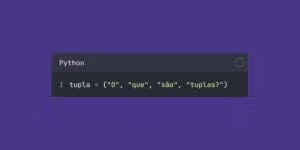

Python provides several built-in collection types, but beginners often wonder which one to choose. The most common options are list, tuple, set, and dictionary. They can all store multiple values, yet they have different rules for ordering, duplicates, mutability, and access.
This guide compares the four structures with practical examples. By the end, you will know when a list is the best choice, when a tuple communicates fixed data, when a set improves membership checks, and when a dictionary is ideal for key-value information.
For a broader introduction, review the Python data types guide and the official Python data structures tutorial.
Quick Comparison
| Type | Ordered | Mutable | Duplicates | Main Access |
|---|---|---|---|---|
| List | Yes | Yes | Yes | Index |
| Tuple | Yes | No | Yes | Index |
| Set | No positional order | Yes | No | Membership |
| Dictionary | Insertion order | Yes | Keys are unique | Key |
“Ordered” means that the collection preserves a meaningful sequence for iteration. A set should not be used when you need a stable position such as “the first item.”
Python Lists
A list is an ordered, mutable collection. It is usually the default choice when you need a sequence that can grow or change.
languages = ["Python", "JavaScript", "Go"]

print(languages[0])
languages.append("Rust")
languages[1] = "TypeScript"
print(languages)
Lists allow duplicate values:
scores = [10, 8, 10, 7]
print(scores.count(10))  # 2
Useful List Methods
append(value): add one item.extend(iterable): add several items.insert(index, value): insert at a position.remove(value): remove the first matching item.pop(): remove and return an item.sort(): sort the list in place.
The complete Python lists guide covers slicing and common methods in more detail.
Python Tuples
A tuple is an ordered collection that cannot be changed after creation. This property is called immutability.
point = (12, 8)
print(point[0])

# point[0] = 20  # TypeError
Tuples work well for fixed records such as coordinates, RGB values, database rows, or values returned together from a function.
def dimensions():
    return 1920, 1080

width, height = dimensions()
print(width, height)
A single-item tuple needs a trailing comma:
not_a_tuple = (5)
one_item_tuple = (5,)

print(type(not_a_tuple))
print(type(one_item_tuple))
Python Sets
A set stores unique, hashable values. It is especially useful for removing duplicates and checking membership efficiently.
tags = {"python", "api", "python", "web"}
print(tags)
print("api" in tags)
Create an empty set with set(). Empty braces create a dictionary:
empty_set = set()
empty_dict = {}
Set Operations
backend = {"Python", "Go", "Java"}
data = {"Python", "R", "Julia"}

print(backend | data)  # union
print(backend & data)  # intersection
print(backend - data)  # difference
print(backend ^ data)  # symmetric difference
The Python in operator guide explains membership tests across different collections.
Python Dictionaries
A dictionary maps unique keys to values. It is the natural choice for structured information where each value has a meaningful label.
student = {
    "name": "Maya",
    "age": 24,
    "course": "Python",
}

print(student["name"])
student["age"] = 25
student["active"] = True
Use get() when a key may be missing:
city = student.get("city", "Unknown")
print(city)
Iterate through keys and values with items():
for key, value in student.items():
    print(f"{key}: {value}")
Mutability Explained
Lists, sets, and dictionaries are mutable. You can add, remove, or replace their contents. Tuples are immutable.
Mutability matters when the same object is shared by several variables:
first = [1, 2, 3]
second = first
second.append(4)

print(first)  # [1, 2, 3, 4]
Both names refer to the same list. Create a shallow copy when you need an independent top-level list:
second = first.copy()Hashable Values and Dictionary Keys
Set members and dictionary keys must be hashable. Immutable values such as strings, numbers, and tuples of hashable items normally work. Lists and dictionaries do not.
locations = {
    (40.7128, -74.0060): "New York",
    (51.5072, -0.1276): "London",
}
This is one reason tuples are useful: they can represent a fixed compound key.
Convert Between Collection Types
numbers = [3, 1, 3, 2]

unique = set(numbers)
ordered_unique = list(dict.fromkeys(numbers))
as_tuple = tuple(numbers)

print(unique)
print(ordered_unique)
print(as_tuple)
list(dict.fromkeys(numbers)) removes duplicates while preserving the first occurrence order.
Choose the Right Collection
Use a List When
- Order matters.
- Values may repeat.
- You need to append, remove, or reorder items.
- You access items by index or slice.
Use a Tuple When
- The group of values should not change.
- You want to communicate a fixed record.
- The value may be used as a dictionary key.
- A function returns several related values.
Use a Set When
- Every value should be unique.
- Fast membership checks are important.
- You need union, intersection, or difference.
- Positional order is not required.
Use a Dictionary When
- Each value has a meaningful key.
- You need quick lookup by identifier.
- You are representing records or configuration.
- You are counting, grouping, or indexing data.
Practical Example: Organize Course Data
course = {
    "title": "Python Fundamentals",
    "topics": ["variables", "loops", "functions", "lists"],
    "instructors": ("Alex", "Sam"),
    "required_tools": {"Python", "VS Code"},
}

course["topics"].append("dictionaries")

for topic in course["topics"]:
    print(topic)

print("Python" in course["required_tools"])
This example combines all four types. The dictionary labels each category, the list stores an editable sequence, the tuple stores a fixed instructor pair, and the set guarantees unique tool names.
Comprehensions
Python can build lists, sets, and dictionaries with concise comprehension syntax:
numbers = range(1, 6)

squares_list = [number ** 2 for number in numbers]
squares_set = {number ** 2 for number in numbers}
squares_dict = {number: number ** 2 for number in numbers}
Read the list comprehensions guide before using complex nested expressions.
Performance Considerations
Choosing a collection should begin with meaning and correctness, not micro-optimization. Still, a few general patterns matter:
- Lists and tuples provide direct indexed access.
- Sets and dictionaries usually provide fast membership and key lookup.
- Checking membership repeatedly in a large list can be slower than using a set.
- Tuples may use slightly less memory than equivalent lists, but clarity is the main reason to choose them.
The Python documentation for built-in types provides exact behavior and method references.
Common Mistakes
- Using
{}when you intend to create an empty set. - Expecting a set to preserve positional order.
- Using a mutable list as a dictionary key.
- Accessing a missing dictionary key with brackets when
get()is safer. - Choosing a tuple only because it looks shorter.
- Modifying a list while iterating over it.
For clean loops over collections, see enumerate() and sort() vs sorted().
Frequently Asked Questions
Is a tuple always faster than a list?
Some operations may be slightly cheaper, but the correct semantic choice matters more. Use a tuple for fixed data and a list for editable sequences.
Can a set contain dictionaries?
No. Dictionaries are mutable and not hashable.
Do dictionaries preserve order?
Modern Python dictionaries preserve insertion order. Access is still based on keys, not numeric positions.
How do I remove duplicates but keep order?
Use list(dict.fromkeys(values)) for hashable values.
Conclusion
Use lists for editable sequences, tuples for fixed records, sets for uniqueness and membership, and dictionaries for key-value data. The best choice describes the meaning of your information and makes later code easier to understand.
Practice by taking one small program and replacing a collection type. Observe which operations become clearer and which no longer fit. That comparison builds stronger intuition than memorizing rules alone.